|


14 DAY FREE TRIAL
Try Before you buy

HAND QUALITY
Durable Leathers


HAND DESIGNED
By Horse Owners

INTERCHANGEABLE
Unique Gullet System
14 DAY FREE TRIAL
Try Before you buy
HAND QUALITY
Durable Leathers
HAND DESIGNED
By Horse Owners
UNIQUE INTERCHANGEABLE
Gullet System
Breastplates and Martingales: Which Does Your Horse Actually Need?
11
Jun

Breastplates and Martingales: Which Does Your Horse Actually Need?
Walk into any tack shop or browse any equestrian website and you will find breastplates and martingales displayed alongside saddles, bridles, and bits as standard pieces of kit. For some horses, they are essential. For others, they are solutions to problems that do not exist.
The trouble is that tack has a habit of accumulating. Someone at the yard says a running martingale helped their horse, so you try one. It does not seem to do much harm, so it stays on. Before long, you are riding in three pieces of auxiliary tack and cannot quite remember why.
This guide is about making clear, horse-centred decisions. What do breastplates and martingales actually do? When does a horse genuinely benefit from them? And when is the answer simply to school more?
What Is a Breastplate?
A horse breastplate UK is a piece of tack that connects across the chest and attaches to the saddle. It is not primarily a schooling aid. It is a practical piece of equipment for horses whose conformation or work makes it a useful addition to their tack.
Horses with a broad chest, a short back, a round barrel, or a downhill build are more likely to experience saddle slip. A breastplate gives the saddle something to anchor against when the horse goes uphill, jumps, or works on steep terrain.
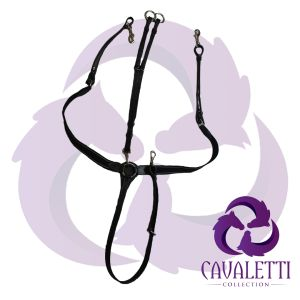
There are two main designs: the hunting breastplate and the five-point breastplate. They work differently and suit different situations.
What Is a Martingale?
A martingale is a schooling and safety aid that prevents the horse from raising its head above a useful working position. It does not lower the head. It sets a ceiling on how high the head can go, and what happens within that range is determined by training.
There are two main types: the running martingale, which works through the reins, and the standing martingale, which attaches to the noseband.
A martingale fitted correctly and on a horse who genuinely needs it is a useful and ethical tool. Fitted too tightly or used as a substitute for training, it creates tension rather than resolving it.
Hunting Breastplate vs Five-Point Breastplate
The hunting breastplate is the traditional design. A strap runs across the chest, two straps go up to the D-rings on the front of the saddle, and a loop goes between the front legs to attach to the girth. A running martingale attachment is often incorporated.
It is a reliable, versatile piece of tack. For general riding, hacking over varied terrain, and light jumping, it does its job well.
The five-point breastplate was developed specifically for jumping. It has five attachment points: two at the front of the saddle, one at the girth on each side, and one passing under the belly. This distributes the load differently and gives significantly more stability across the saddle during the effort and landing phases of a jump.
For riders doing regular jumping above a modest height, particularly cross-country where the saddle faces significant forward force on approach and landing, the five-point is the more secure option. For leisure hacking and light flatwork, the hunting breastplate is usually more than sufficient.
For a detailed comparison specifically for jumping, see our guide on 5-point breastplate vs hunting breastplate.
Running Martingale vs Standing Martingale
These two martingales work differently and are not interchangeable
Running martingale
A running martingale attaches to the girth between the front legs and splits into two straps, each with a ring that the reins pass through. When the horse raises the head above the level of the martingale rings, downward pressure is applied through the reins and the bit. Below that point, the martingale is passive.
The running martingale works indirectly through the reins. It is mild when correctly adjusted and gives the horse freedom to use their neck in normal movement. It is permitted in most disciplines.
Standing martingale
A standing martingale attaches to the girth and to the cavesson noseband. It sets a physical limit on how high the head can go by preventing the nose from rising above a certain point. It does not work through the reins at all.
The standing martingale is more direct than a running martingale. It gives no release when the horse comes back to a useful head position. It is not permitted in dressage and is used mainly in showing and some jumping contexts.
For a detailed comparison of both types, see our running martingale vs standing martingale guide.
Does Your Horse Actually Need a Martingale?
The key question: Does Your Horse Actually Need a Martingale? And the honest answer is that many horses go better without one.
A martingale should be a response to a specific problem. If your horse consistently works above the bit in a way that makes riding unsafe or difficult to address through schooling, a martingale may help. If your horse occasionally pops its head up on landing or when spooking, a martingale adds a safety margin.
But if you are reaching for a martingale because the horse is behind the leg, inconsistent in the contact, or resisting a transition, the martingale is not the answer. Those are training questions, and adding equipment to mask them usually makes them harder to solve in the long run.
The same logic applies to breastplates. If your saddle is slipping because it does not fit your horse, a breastplate holds it in the wrong place more firmly. It is not a substitute for a saddle that fits.
If you are questioning whether your saddle fits, the next honest step is to try one that does. Our 14-day saddle trial lets you ride in a Cavaletti Collection saddle on your own horse before you commit. Or use our fitter locator to find a qualified fitter in your area.
Fitting Both Correctly
A breastplate that is too tight restricts shoulder movement and can cause rubbing. When fitted correctly, you should be able to fit a fist between the chest strap and the horse's chest. The straps to the saddle should be snug but not pulling on the saddle panels.
A running martingale fitted too short forces the reins into an angle even when the horse's head is in a neutral, working position. This creates constant pressure and can cause the horse to come behind the bit or become tense in the neck. Correct length means the rings should reach the throat when the martingale is held up toward the gullet.
A standing martingale fitted too tightly restricts the horse's ability to balance, particularly on landing from a jump. The horse needs their neck to rebalance. A tight standing martingale prevents this and increases the risk of a fall.
Fit both correctly or not at all. For guidance on breastplate fitting specifically, see our guide on how to fit a breastplate.
Our fitting guide covers the whole tack picture. And if you want to have a conversation about what your horse actually needs, contact the Cavaletti Collection team.
Recent Posts
-
Weighted stirrups: do they actually help your position?
 September 4, 2026
 -
When to Replace Your Stirrup Leathers: The Warning Signs
 August 31, 2026
 -
Black vs Brown Reins: Does Matching Your Bridle Actually Matter?
 August 28, 2026
 -
How to Choose the Right Safety Stirrups for Jumping
 August 24, 2026
 -
Stirrups, Reins and Stirrup Leathers: Getting Your Leatherwork Right
 August 19, 2026